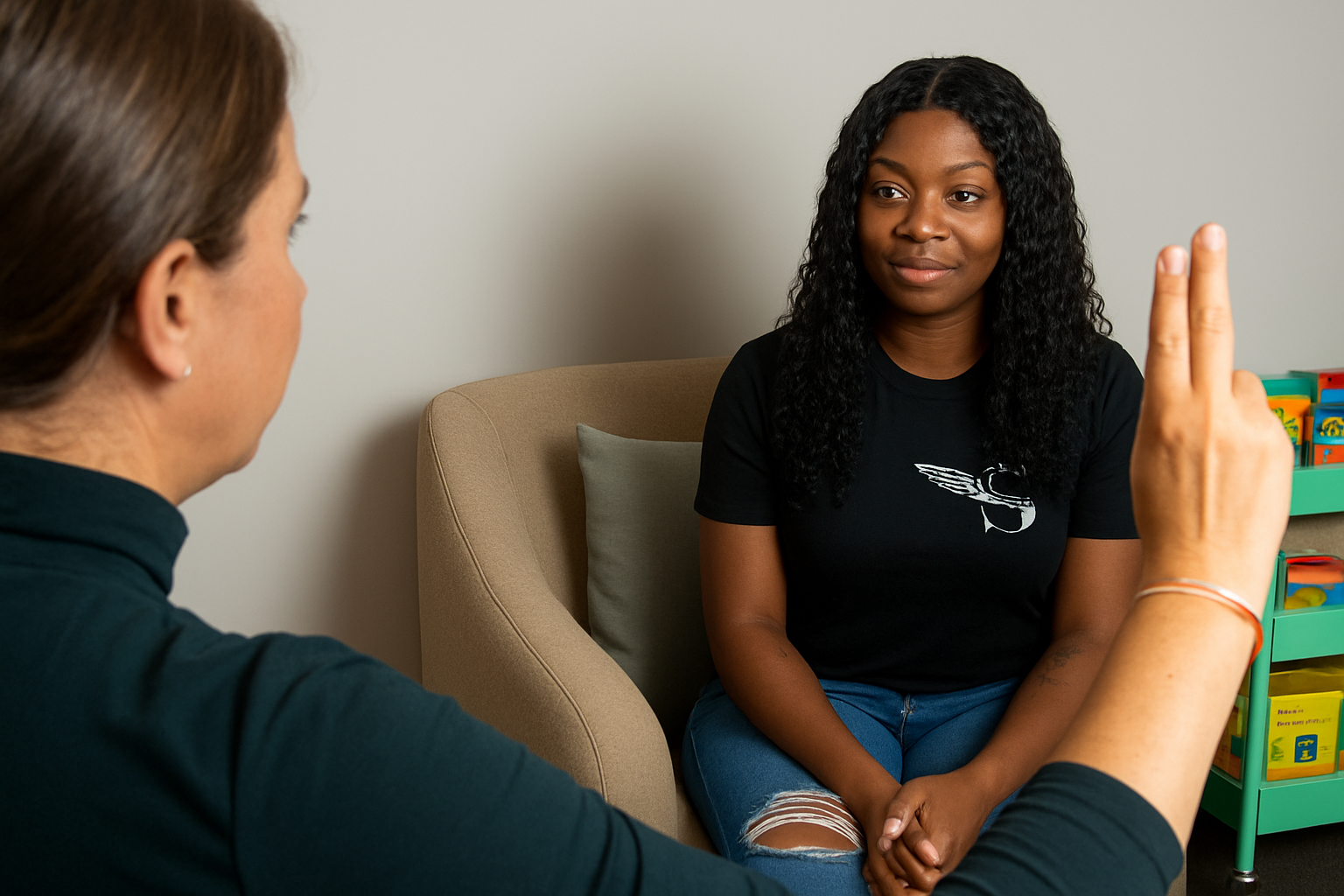

Imagine knowing exactly what you want to say or wanting to join a fun game with classmates, but feeling too scared or nervous to speak. For children with Selective Mutism (SM), speaking in certain situations can feel overwhelming, even when they genuinely want to communicate and participate.
Before October ends, in recognition of Selective Mutism Awareness Month, we’re shining a light on selective mutism, what it is, effective treatment approaches, and how parents, teachers, and clinicians can work together to create supportive environments where children build confidence and find their voices.
What Is Selective Mutism?
Selective Mutism (SM) is an anxiety disorder characterized by a consistent inability to speak in certain social situations where speaking is expected, despite being able to speak in other settings. For example, a child may talk freely, tell jokes, and be silly at home but have significant difficulty speaking with teachers, extended family members, or peers at school.
Selective Mutism is not a matter of being stubborn, defiant, or simply choosing not to speak. For many children, speaking in certain environments triggers significant anxiety, making verbal communication feel difficult or even impossible.
Selective Mutism can vary across settings, people, and activities. A child may communicate comfortably with one person or in one environment while experiencing significant difficulty speaking with others. As a result, SM may be much more apparent in some situations than in others.
What Might Selective Mutism Look Like?
Although every child’s experience is unique, some common signs of Selective Mutism include:
- Speaking comfortably and freely at home while remaining silent at school.
- Communicating through gestures, pointing, whispering, or other nonverbal sounds.
- Having difficulty answering questions, greeting others, or asking for help.
- Appearing frozen, tense, or withdrawn when expected to speak.
- Experiencing difficulty ordering food, making requests, or verbally interacting in community settings.
Understanding these behaviors through the lens of anxiety, rather than unwillingness, is an important first step in providing meaningful support.
What Is an “Exposure Lifestyle”?
An exposure lifestyle is a common concept in Selective Mutism treatment. It refers to creating regular, intentional opportunities for children to practice communicating with different people and in different environments. These experiences help children gradually expand their comfort with speaking and build confidence across settings.
Importantly, exposures should be individualized, gradual, developmentally appropriate, and guided by the child’s treatment plan.
An exposure lifestyle might include:
- Practicing greetings with familiar people and gradually expanding to less familiar individuals.
- Playing games that create natural, low-pressure opportunities for verbal communication.
- Practicing how to order a preferred item in a community setting.
- Practicing a previously accomplished speaking skill in a new location or with a different person.
The goal is to create meaningful opportunities for children to communicate while participating in enjoyable activities, building relationships, and experiencing success. Speaking practice should feel purposeful and supportive.
Treatment Options: What Does Progress Look Like, and How Long Does It Take?
One of the most important messages for families is that Selective Mutism is treatable, and children can make significant progress with specialized, evidence-based support.
Treatment typically focuses on gradually increasing communication across settings and helping caregivers support brave talking. Behavioral interventions often incorporate gradual exposure, structured speaking practice, positive reinforcement, and caregiver involvement.
There is no one-size-fits-all timeline for treatment. A child’s progress may depend on several factors, including age, developmental needs, current communication, severity of anxiety, and the level of support available across home, school, and community settings.
Progress may begin with small but meaningful steps, such as whispering to someone new, answering a fact-based question, or speaking with a familiar person in an unfamiliar setting. Each step helps build the foundation for future growth.
How Caring Cove Can Support You and Your Family
Every brave step counts. With patience, understanding, and the right support, children can develop communication skills and build confidence at their own pace.
At Caring Cove, we offer several services to support children with Selective Mutism and their families.
Individual Treatment: PCIT-SM
Parent-Child Interaction Therapy for Selective Mutism (PCIT-SM) is an individualized, evidence-based behavioral treatment that empowers caregivers to support their child’s communication through relationship building, structured speaking practice, and gradual exposure.
Treatment incorporates clinician-guided parent coaching, structured practice in the clinical setting, collaboration with school personnel, and opportunities to practice brave talking in everyday community environments. By equipping caregivers with strategies, PCIT-SM helps families support their child’s communication progress both inside and outside the therapy room.
Group Therapy (Children Ages 3–7 and 7–10)
Group therapy provides children experiencing SM and/or social anxiety with opportunities to practice communication skills alongside peers in a supportive, structured environment with trained group facilitators.
Through engaging activities, children work toward communication goals such as answering questions, asking for help, raising their hands, participating in classroom activities, and gradually building toward more challenging speaking opportunities, such as Show and Tell presentations.
Activities are designed to help children develop confidence at their own pace while expanding their comfort speaking with both peers and adults.
To support a successful transition, new clients complete a group intake process and introductory fade-in sessions before joining the group. This gradual introduction allows clinicians to individualize support and help each child feel increasingly comfortable in the group environment.
Intensive Treatment Program: Mighty Mouth Kids (MMK) Camp -NJ
Mighty Mouth Kids (MMK) Camp- NJ is an intensive, evidence-based treatment program based on Dr. Steven Kurtz’s MMK Camp designed to help children with Selective Mutism strengthen their communication skills and build confidence across settings.
Through structured opportunities for brave talking, children practice communicating during play, classroom activities, mealtimes, and community outings. With a 1:1 counselor-to-child ratio, individualized speaking goals, and gradual exposure opportunities, children work towards skills such as engaging with peers, answering questions, participating in discussions, presenting in front of a group, and communicating in everyday situations.
Parent training and coaching help families learn strategies to reinforce progress and continue supporting their child’s communication skills long after camp concludes.
Supportive Parenting for Anxious Childhood Emotions (SPACE) Parenting Group
Parents play an important role in helping children navigate anxiety, and they deserve support, too.
Caring Cove’s Supportive Parenting for Anxious Childhood Emotions (SPACE) Parenting Group helps caregivers better understand childhood anxiety and develop evidence-based strategies for responding to it.
The group explores how everyday accommodations, although often well-intentioned, can unintentionally reinforce anxiety and how caregivers can make thoughtful changes while maintaining a supportive, connected relationship with their child.
Parents leave with practical tools to respond to their child’s anxiety with greater confidence while fostering gradual growth in independence, flexibility, and resilience.
Parent Group: Navigating Selective Mutism and Social Anxiety During The Holiday Season
Group sessions for parents of children with social anxiety and selective mutism to learn evidence-based techniques to live an exposure lifestyle and encourage brave talking during the holiday season.
Topics include:
- Navigating common holiday challenges, including family gatherings, conversations with relatives, and unfamiliar social situations.
- Identifying everyday opportunities to incorporate exposures into holiday routines and social gatherings.
- Maintaining momentum by celebrating successes and embracing an “exposure lifestyle” to support ongoing growth.
Intensive Half-Day Field Trip to LifeTown Shoppes
Caring Cove’s biannual field trip to LifeTown in Livingston, NJ, provides children with an exciting opportunity to practice brave talking in an intensive, real-world community setting.
With a low clinician-to-parent-child ratio, clinicians coach caregivers through structured exposures designed to help children generalize their communication skills beyond the therapy room.
LifeTown offers a variety of simulated community environments, including stores, a movie theater, and a medical office. These settings create meaningful opportunities for children to practice speaking with peers and adults while navigating everyday social interactions.
By bringing treatment strategies into a familiar community-based experience, children can work toward greater confidence communicating in a variety of situations.
Every Brave Step Counts
Hope does not mean expecting a child’s symptoms to be gone overnight. It means recognizing that, with evidence-based interventions and consistent support, progress can happen one step at a time.
A child who speaks to one new person, asks for help at school, or participates in an activity that once felt impossible is making meaningful progress. These moments may seem small to others, but they represent significant steps toward greater confidence, communication, and independence. At Caring Cove, we love to celebrate this progress with you!
With appropriate treatment, collaboration, and ongoing encouragement, children can develop the confidence and skills needed to communicate more comfortably across settings.
At Caring Cove, we are dedicated to helping children build confidence, navigate challenges, and discover their brave voices. Just as importantly, we want parents to feel supported, empowered, and reminded that they are never alone on this journey.
Whether you have questions, are seeking guidance, or are interested in our services, we are here to help. Please don’t hesitate to reach out.
References
Cornacchio, D., Furr, J. M., Sanchez, A. L., Hong, N., Feinberg, L. K., Tenenbaum, R., Del Busto, C., Bry, L. J., Poznanski, B., Miguel, E., Ollendick, T. H., Kurtz, S. M. S., & Comer, J. S. (2019). Intensive group behavioral treatment (IGBT) for children with selective mutism: A preliminary randomized clinical trial. Journal of Consulting and Clinical Psychology, 87(8), 720–733. https://doi.org/10.1037/ccp0000422
Catchpole, R., Young, A., Baer, S., & Salih, T. (2019). Examining a novel, parent child interaction therapy-informed, behavioral treatment of selective mutism. Journal of Anxiety Disorders, 66, 102112. https://doi.org/10.1016/j.janxdis.2019.102112
Renk, K., Daleandro, K., Verdone, M., Al-Bassam, H., & Murphy, Q. (2025). Understanding Selective Mutism in Very Young Children. Behavioral Sciences, 15(7), 923. https://doi.org/10.3390/bs15070923